
Hey there, friend. Welcome. If you’ve ever felt like you’re running a race where the finish line keeps moving, or if you’ve spent your Sunday nights feeling a heavy knot in your stomach about the coming work week, you’re not alone. We’ve all been told that if we just work hard, pay our taxes, and sign that 30-year mortgage, we’ll eventually reach the "American Dream."
But what if that dream is actually a rigged carnival game? What if the system isn't designed for you to win, but simply to keep you throwing the ball until your pockets are empty?
Today, we are going to pull back the curtain on "Freedom Economics." We’re moving past the traditional financial advice and diving into a philosophy that prizes time over digits in a bank account. Whether you are looking for self-sufficient living ideas or searching for sustainable living tips, this journey is about reclaiming your life from a system that views you as a battery rather than a human being.
You can watch the full discussion on this topic here: Freedom Economics: Why the 30-Year Mortgage is a Rigged Carnival Game
The Cautionary Tale: A Lifetime of Labor, Vanished
Let’s start with a story that hits close to home: a story that changed the way we view the world here at 7 Kin Homestead. It’s the story of a father-in-law who did everything "right." He worked a steady job for decades, contributed to his retirement, and played by every rule the system laid out. He was the epitome of the hardworking American.
But when it came time to cross that finish line and enjoy the fruits of his labor, the system shifted. Through a combination of corporate restructuring and economic volatility, his retirement: the "security" he had traded thirty years of his life for: was largely wiped out.
He didn't lose his money because he was lazy or irresponsible. He lost it because he was playing a game where the house always wins. This is the gritty reality of modern economics: you can give your best years to a corporation, but you are ultimately a line item on a spreadsheet. When the numbers don't add up for them, you are the one who pays the price. Seeing that happen to a loved one is a remarkable wake-up call. It forces you to ask: Why am I still playing this game?
The Whiffle Ball Analogy: Why You Can’t Win
Imagine you’re at a local fair. There’s a booth where you have to throw a light, plastic Whiffle ball into a basket to win a giant teddy bear. It looks easy, right? But the wind is blowing, the ball is too light to stay on track, and the basket is designed with a hidden slant that bounces the ball right back out.
That is the 30-year mortgage. That is the debt-based lifestyle.
The "wind" is inflation, which erodes the value of the money you're trying to save. The "slant" is interest, which ensures that for the first decade of your home ownership, you aren't actually buying a home: you’re just paying the bank for the privilege of sitting in it. The system is designed to keep you "throwing the ball." As soon as you get close to paying off a debt, a new "need" is manufactured: a better car, a bigger house, a new subscription.
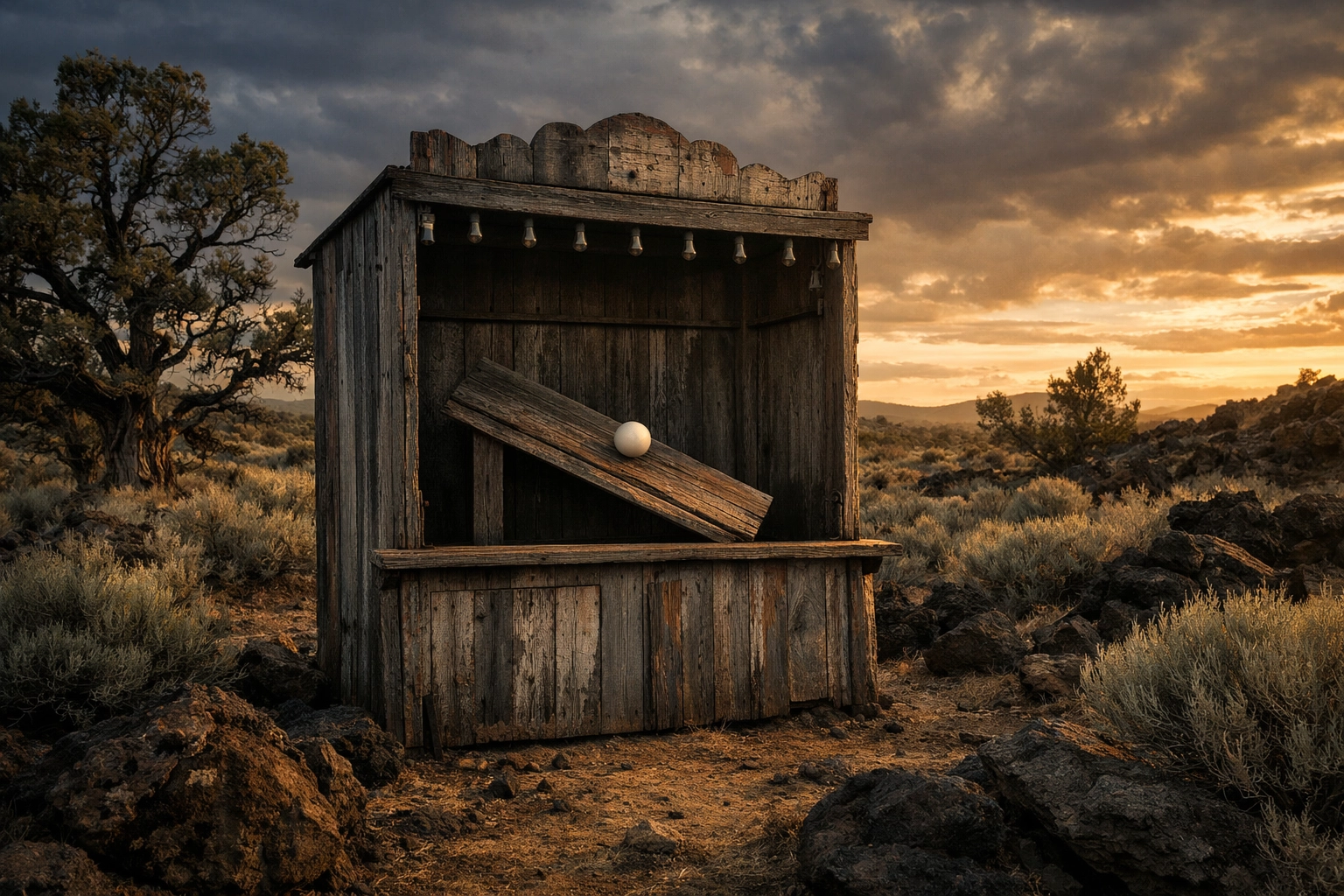
We are conditioned to stay in the game because we think the next throw will be the one that lands. But in the current economic structure, the game is rigged to keep you in a state of perpetual "almost."
Trading Hours for Discounted Dollars
To understand how to escape, we have to talk about the "Discounted Dollar." When you work a traditional corporate job, you are trading the most valuable thing you own: your time: for a currency that is taxed at every level.
Think about it:
- Your time is taxed (Income Tax).
- Your spending is taxed (Sales Tax).
- Your savings are taxed (Inflation/Capital Gains).
- Your "ownership" is taxed (Property Tax).
By the time you actually use the dollar you earned through an hour of your life, that dollar has been "discounted" by nearly 40-60% in terms of its actual purchasing power and the value of the time it took to earn it. You are effectively working for half-price while the system takes the rest.
On the homestead, we look at economics differently. When we embark on a project: like building a chicken coop or planting an orchard: we get 100% of the value of our sweat. If I spend five hours building something, I don't have to pay an income tax on my labor. I don't have to pay a sales tax on the finished product. The value stays with our family. This is the secret to how to live off grid with no money (or at least, very little): stop valuing your life in dollars and start valuing it in utility and autonomy.
Eliminating 'Need' and 'Want' to Reclaim Time
The path to freedom isn't paved with more money; it's paved with fewer requirements. Every "need" you have is a chain that binds you to the rigged game. If you "need" a $600 car payment, you "need" to work 40+ hours at a job you might hate just to service that debt.
We invite you to sit down and unravel your dependencies. What do you actually need to thrive?
- Do you need a 3,000-square-foot house, or do you need a warm, safe place for your family to gather?
- Do you need a brand-new truck, or do you need reliable transportation?
- Do you need a grocery store for every meal, or can you learn the exquisite joy of harvesting from your own garden?
By shrinking your "needs," you suddenly find that you require much less "discounted currency." This is how you reclaim your time. When you reduce your overhead, you reduce the power the "rigged game" has over your life. This is the cornerstone of off grid living on a budget. It’s about being "rich" in time and peace rather than being "plastic rich" in debt-fueled toys.
The Freedom Spectrum: Where Do You Stand?
We like to think of freedom not as a binary choice (on or off), but as a spectrum. On one end, you have "Indentured Servitude": where 100% of your time is traded for the basic requirements of survival. On the other end, you have "Absolute Autonomy": where you own your land, your time, and your resources outright.
Most of us start somewhere near the servitude end. The goal of 7 Kin Homestead is to help you move, step by step, toward autonomy.
- Level 1: Awareness. Recognizing that the game is rigged.
- Level 2: Debt Reduction. Stopping the bleeding of interest and "wants."
- Level 3: Skill Acquisition. Learning to produce what you currently consume.
- Level 4: Land Ownership. Finding a piece of earth that the system can't easily take away.
- Level 5: Total Autonomy. Living off the interest of your own labor and the abundance of the land.

Thriving on the Homestead
Embarking on this journey is a magnificent adventure. It’s about more than just "buying land"; it's about buying your life back. When you move toward sustainable living tips and self sufficient living ideas, you aren't just becoming a farmer or a gardener: you’re becoming a free human being.
You don't need a million dollars to start. You just need a shift in perspective. Start where you are. Grow a tomato in a pot. Pay off that one small credit card. Watch our videos to see how we are navigating the "Freedom Economics" of our own homestead.
We are a community of people who decided that the carnival game wasn't worth the price of admission. We chose the serenity of the woods over the stress of the cubicle. We chose the beauty of a sunset over the blue light of a spreadsheet.
Are you ready to stop throwing the Whiffle ball?
Start your adventure today. Explore our Community to connect with others who are escaping the game, or read more about our journey on our About page.
The wind is blowing, and the basket is slanted. It's time to walk away from the booth and go build something of your own.
Categories: homestead economics, buying land
Keywords: how to live off grid with no money, off grid living on a budget, self sufficient living ideas, sustainable living tips.
Want to learn more? Check out our latest blog posts for more insights on thriving outside the system!